Tuesday, May 20, 2014

Plant Transpiration Online Lab


JOURNAL QUESTIONS

1) Describe the process of transpiration in vascular plants.
  This is the process of which plants lose excess water into the atmosphere through the stomata located on the underside on the plant. leaves. Most of the water absorbed by the plant's root is lost through transpiration. During photosynthesis, stomatas open to allow the intake of carbon dioxide and the release of oxygen. In this process, large amounts of water are lost to the enviornment via transpiration. 

2) Describe any experimental controls used in the Investigation.
  The control of the experiment is the transpiration of the plants under regular conditions and time intervals (same heat, without fan/heater/lamp).

3) What environmental factors that you tested increased the rate of transpiration? Was the rate of transpiration increased for all plants tested?
  The factors that I tested that increased the rate of transpiration were heat, light, and wind. Wind and heat increased the rate of transpiration for all the plants, but the light only increased the rate of transpiration for the arrowhead, coleus, devil's ivy, english ivy, and geranium plants.

4) Did any of the environmental factors (heat, light, or wind) increase the transpiration rate more than the others? Why?
Overall, wind yielded the highest transpiration rate out of all the factors. Different plants transpire at different rates in order to be well-adapted to the different environments they live in. 
 5) Which species of plants that you tested had the highest transpiration rates? Why do you think different species of plants transpire at different rates?
  The rubber plant had the highest rate of transpiration. Different plants transpire at different rates in order to be well-adapted to the different environments they live in. 

6) Suppose you coated the leaves of a plant with petroleum jelly. How would the plant's rate of transpiration be affected?
  Transpiration would be unable to take place because the petroleum jelly covers the stomatas of the leaves, not allowing neither oxygen and water vapor to leave the plants and prevents carbon dioxide from entering the plant. 

7) Of what value to a plant is the ability to lose water through transpiration?
Transpiration allows the plant to regulate homeostasis, humidity in the atmosphere, and moisture in the soil. Water that becomes part of the transpiration process is used as a vehicle to deliver nutrients from the soil into the plant. 

Monday, May 19, 2014

Plant Hormones


AUXIN
Auxin is the plant hormone responsible for stimulating and controlling plant growth. Auxin is made in actively growing tissue including young leaves, fruits, the shoot apex, and the root. In phototropism, the shaded side of the shoot in a plant will contain more auxin, thus compelling the plant to grow away from the shaded side and towards the light. While in a root cell, though the shaded side of the root will contain more auxin, the shaded side will grow less than the lit side and cause the root to grow away from the light. Auxin is also involved in gravitropism. If a shoot is placed horizontally, the bottom side will contain more auxin than the top side, compelling the bottom side to grow more than the top side. This causes the shoot to bend and grow against the force of gravity and in the correct direction. If a root is placed horizontally, the bottom side will contain more auxin than the top side, causing the bottom side to grow less than the top side. This allows the root to bend in the direction of the force of gravity and grow in the correct direction. The growing pattern and the concentrations of auxin in the plant can be described in the five models for auxin transport. On a cellular level, auxin is essential for cell growth, promoting cellular division and cellular expansion. Auxin contributes to cell differentiation and specification. Depending on the type of tissue, auxin may compel axial elongation (shoots), lateral expansion (roots), or isodiametric expansion (fruits). 

http://upload.wikimedia.org/wikipedia/commons/thumb/9/97/Model_for_auxin_transport.png/330px-Model_for_auxin_transport.png

http://www.plant-hormones.info/iaa.gif


http://www.plant-hormones.info/went1.gif


ABSCISIC ACID
Abscisic acid (ABA) is a plant hormone also known as abscisin II and dormin. It functions in many plant development processes. Abscisic acid stimulates the closure of the stomata, inhibits shoot growth, induces seeds to synthesize storage proteins, inhibits the affect of gibberellins on stimulating de novo synthesis of a-amylase, effects induction and maintenance of dormancy,  and induces gene transcription. Abscisic acid is also the plant hormone that responds to weather stresses such as cold and drought. ABA maintains the dormancy in seed germination, ensuring its growth in the most advantageous environment. 
http://www.plant-hormones.info/aba.gif

ETHYLENE
Ethylene is commonly used in the agricultural industry. Commercial fruit farmers control the timing of the fruit ripening with the application of ethylene gas. Horticulturalists inhibit leaf dropping in ornamental plants by removing ethylene from green houses using fans and ventilation. Ethylene is a hormone that stimulates fruit ripening, flower wilting, and leaf fall. Aging tissues and nodes of stems also produce ethylene. The most well-known effect of this hormone is the compulsion of fruit ripening. It stimulates the conversion of starch and acids to sugars. One trick people use to accelerate the ripening of fruit is to seal unripe food in a paper bag and let the gas released by the first fruit to mature trigger the ripening of the remaining fruit. Ethylene also plays a role in fruit abscission and flower fading/dropping. 
http://www.chinadaily.com.cn/lifestyle/2006-06/01/xin_050603011349097195622.jpg

Wednesday, May 14, 2014

Flower Power


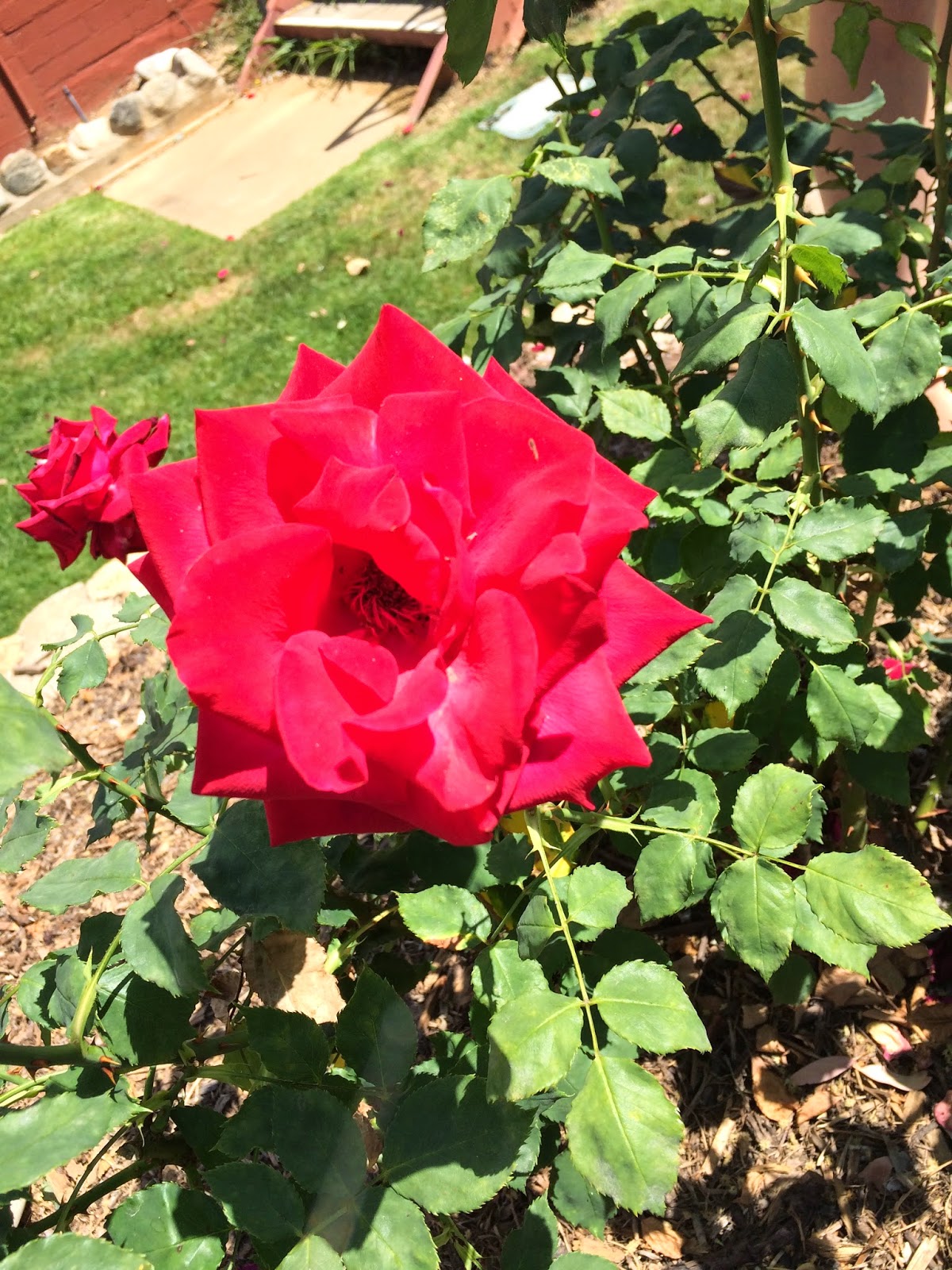
This rose has multiple layers of vibrantly pigmented petals. It also has a pleasant soft sweet scent. The flower grows at the very top of the bush, allowing easy access by insects. At the very center of the flower, it contains multiple stamens (male) with anthers (creates pollen) blanketed in layers of powdery pollen. The stamens surrounds the single pistil (female). This ensures that insects looking for nectar in the rose are covered in pollen and coat the stigma full of pollen.


This flower's five petals create a target at the very center for insects. The color also fade from deep and bold to light and vibrant. This bush is located on ground level, making it more available to smaller organisms.The flower doesn't give off a distinct scent, but it's stark contrast in color with its straight pointed leaves make it stand out to attention. It contains a couple of stamens, surrounding one tall pistil with a sticky stigma (in order to trap pollen.) The insect must reach deep into the flower in order to access the nectar, in turn also knocking the stamens and pistils together, transferring pollen. Once the insect leaves the flower, it will also rub the pollen is covered in on the stigma. 


 This flowering tree has flowers that grow in a bunch with its opening faced down. The flowers of this tree give off a bubble bath scent. It is most likely that small insects pollinate these flowers because of the small size and the positioning of the flowers.  Its soft pink shade makes it aesthetically desirable.


 The stamens and the pistils. 


The tree bark itself is extremely smooth, not made to ward off unwelcomed consumers. It also extends its leaves widely, creating shade.


There were a large number of ants crawling up and down the tree. It is most likely that they are present for the nectar of the small flowers. 

Wednesday, April 30, 2014

Botany of Desire Excerpt


http://www.imgion.com/images/01/Pink-Flower-With-High-Revolution-.jpg

Flowers manipulate themselves to be desired as a part of co-evolution in order to advance its own interest. In co-evolution, two parties act on each other to advance their individual interest and end up trading favors. The relationship between a honey bee and a flower is an example of co-evolution. Both parties benefit from each other, the bee gets food and the flower is able to reproduce. The flowers create a scent or an aesthetic appearance, exploiting the honey bees desire.

http://old.termiguardusa.com/European-Honey-Bee.jpg

Similarly, agriculture is an example of co-evolution between humans and "domesticated" agricultural products. Just like how the apple blossom's form and scent has been selected by bees, potatoes have been selected over several generations by humans for mass production. Apples entice us with its sweetness, tulip with its beauty, cannabis with its intoxication, and potato with its taste.

http://portfolios.chuckhaney.com/data/photos/416_1sugarbeet_field_copy.jpg

Plants make themselves desired to animals in order to be able to pass on its genes to the next generation. The plants able to do this the most effectively will multiply. Our semiconscious awareness to our choices of plants is a part of evolution. Humans regard plants and agriculture by desire while they act on humans, getting them to aid their interest in reproducing.

http://www.publicdomainpictures.net/pictures/10000/nahled/87-1265716619irEO.jpg

This also reflects Charles Darwin's theory of survival of the fittest. The plants manipulate themselves to fit our desires in order to make itself dominant in human agriculture, multiplying its population exponentially greater than wild plants that have not learned to do so yet. Darwin uses the term artificial selection to define the process in which domesticated species come into the world. Human desire plays a role in what nature determines is the "fittest" thereby leading to emergence of new forms of life, evolution.

http://www.abc.net.au/news/image/234490-3x2-940x627.jpg


Wednesday, April 23, 2014

Predator/Prey Lab Graph


The purpose of this lab is investigate how populations are affected by predator-prey relationships over several generation. The following data shows the populations of wolves relative to the population of rabbits over 20 generations. As the population of the wolves decreased, the population of the rabbits increased and vice versa. The trend in the graph developed from the data we gathered showed that as the number of predators increased, the number of prey decreased. Over the generations after that, the number of predators would decline due to lack of prey. As a result, the number of prey would increase because of the lack of predators. This trend of predator and prey population would oscillate relative to each other.

Tuesday, April 22, 2014

Biome Disaster: Toxic Waste Spill


A waste spill in the Boreal Forest would devastate and tip the balance of life dependent on the forest.

A few years ago, a toxic waste spill in northern Alberta killed off 42 hectares of the boreal forest. The amount of oil that suffocated the environment was enough to cover 50 football fields. Every tree and plant in contact with the waste died. Waterfowls may have been killed off as well, the spill being in a wetlands region of the Alberta boreal forest. The toxic waste contained crude oil, hydrocarbons, high levels of salt, sulfuric compounds, metals, naturally occurring radioactive materials, chemical solvents, and additives used by the oil industry.


Waste spills in the boreal forest destroy entire ecosystems, produce lake-sized chemical waste, releases toxins, and emits a significant amount of global warming pollutants (more than conventional oil).

Alberta's boreal forest is critical to the survival of the Canadian Lynx. The toxic spill would push the lynx out of its environment, endangering its existence.

Fish and Wildlife conservation officers killed 145 black bears after they were habituated to garbage in the oilsands region.

Canadian officials are also poisoning wolves to make way for the caribou habitat that is threatened by tar sand fuel extraction.

The tar sand oil operations create toxic dumps filled with excess chemicals and oils calling "tailings pond." To birds, they look like a safe place to land. Unfortunately , hundred of birds met their demise with a slow painful death from these sludge pits.

Moose meat tested high in arsenic and carcinogens created by oil mining, endangering the health of anyone or any predator who depends on moose for survival.

Woodland caribou are being driven to the brink of extinction because their habitat is being threatened.

Oil companies require a large amount of water, disrupting the natural cycle of of rivers and surrounding watersheds, endangering many species of fish.

Toxic waste spills devastate every part of the boreal forest because the spills destroy entire ecosystems, affecting every living organism.

SOURCES

National Wildlife Federation

Yahoo News


Thursday, April 17, 2014

The Boreal Forest (The Taiga)

https://blogger.googleusercontent.com/img/proxy/AVvXsEj32cdB2N1s9Gf20XBV4tTxYXu_Iu-0xATpU4XtcRREkhqPV1DWZzhZtW1JB2UeOQkPpn-TyPrZ_Uo7g9Zv3zaW7jvHBcKlIWrdSrwNKv7-obT7gEUMz1_O0Go5JXVFhJENbLFK5cpL7Av4O-jwx6yr7_NtgCVL5BcaZOSgshFAaP2HfusDWLCv5laxLaL4K9gBHn7ym-T2PPyExYZgT3eSWYzrv6O6UGITNqVgloez=

The Boreal Forest is characterized as a biome consisting exclusively of evergreen and coniferous trees. It encircles the earth in far-northern latitudes just below the arctic tundra and just above the deciduous forests and grasslands of the temperate zone. It is the largest terrestrial ecosystem (surpassing the Amazon Rainforest) and remains largely undeveloped. Many people also visit the Boreal Forest just to witness the dancing Aurora Borealis (Northern Lights) in the sky.

https://blogger.googleusercontent.com/img/b/R29vZ2xl/AVvXsEgtFZ6ZAa0jbwDzoR019RLXk8QOBqGdON8UCD4p4OCsH8Lc8Pe7u4RzlGZRahsi3we3ZYeeKAL_0e7NgJu2lCBw7Hkc1LSGiiqND0om3ovTuGlRjQuysmrO5sgDCJwonByUK37AsZwOutwh/s400/mosaic.jpg

LOCATION
http://www.nrdc.org/land/forests/boreal/images/map.gif

ABIOTIC FEATURES

Soil/Minerals.

One might expect the soil conditions in a forest to be fertile and booming with life. However, the the soil in the boreal forest is frozen about 5 to 7 months of the year. Further more, the soil is highly acidic due to fallen conifer needles that accumulate on the forest floor. This, in turn, also provides poor nutrition to vegetation, limiting the types of vegetation that are able to prosper in these soil conditions. When the soil isn't frozen, it's swampy and marshy because the snow melts in late spring followed by heavy rainfall in the short summers that keep the water from being able to completely evaporate.

Precipitation
http://www.skolaiimages.com/journal/wp-content/uploads/2010/11/09_NOV52091.jpg

The boreal forest receives about 8 to 79 inches of precipitation a year, mostly in the form of snow and in the form of rain in the summer.

Air                                                                      http://www.borealbirds.org/images/carbon/piechart-carbon.png

The boreal forest does a fantastic job of purifying the air and regulating the regional climate. The boreal forest also enjoys the higher concentrations of carbon dioxide in our atmosphere due to our consumption of fossil fuels. It is one of the largest carbon reservoirs in the world. It has been enabling growth rates not seen in human history according to a new study. Geochemist Heather Graven of the Scripps Institution of Oceanography and her colleagues documents a dramatic spike in the flow of carbon dioxide into the forest. She states "Boreal Forests are more active than 50 years ago." Her and her colleagues also discovered that the ecosystems are changing (vegetation structures, compositions, photsynthesis timing, leaves, roots, wood) in response to the increasing levels of CO2.

Natural Occurings

Forest fires are extremely common and used to clean up the biome. This also includes the imfamous and beautiful northern lights.


Temperature


The boreal forest is prone to extremely long, harsh winters, and short, mild summers. The cold air blowing down from the arctic creates bitter winters, lasting more that half of the year. Temperatures in the winter oscillates wildly from a high of 30 to a low of -65 degrees Fahrenheit. In the summer, temperatures range from a high of 70 to a low of 30 degrees Fahrenheit. Temperatures usually remain below freezing for more that half the year. The average overall yearly temperature is 32 degrees Fahrenheit (freezing point).


https://blogger.googleusercontent.com/img/proxy/AVvXsEhcqvKqHN3rW4kgw517I8JR7Xo8cTSeLAbzvQwTzfQxiN3VpJaTRb1ULun11qGzy5zrerUKorHgTN69TBhL0XPv_38fjqgmyqF-q4U2ufVdITK15nm44Blm4eWBg4vBVPfofEftjHHRYulSEVF4rXdOU6lS3o6t8M05dD6ptelEkCROiLAd=


Sunlight

Because the boreat forest is located in the northern regions, it receives up to 20 hours of sunlight per day during the summer. While in the wintertime, the forest only receives a few short hours. The long days and mild temperatures during the summer abets and welcomes a rapid burst of plant growth. Unfortunately, the summer growing season only lasts for 3 months before the temperature begins to drop.


BIOTIC FEATURES


https://blogger.googleusercontent.com/img/proxy/AVvXsEg5KUskTU8xuhET5VgTiKWbe27Tf1l8VEf16AV53xC7Fhmwo7Dd7X9F9XzG6Vvv1zFMteGwuPFD7l4vxGQ41gIT_mJK7YRNp6GUGuuZ4P5wF4UCQoSV0-i-pNCg4TRXd2wVyQQ076bq0UCCoeH0LNkRUWpc9Q8bMEkv-3CG2HDzjVrSYTCxgw=

Producers

The producers include the evergreen trees, wild grass, wild flowers, deciduous shrubs, ferns, mosses, and lichens

Consumers

Carnivores: Felids (cats) such as the bobcat, lynx, and siberian tiger. Canids (dogs) such as wolves.\

Herbivores: Deer (elk), moose, arboreal (tree-living), porcupine, snow hare, rodents.

Decomposers

Decomposers: Soil bacteria, nematodes, worms, fungi, protozoans

FOOD WEB
https://blogger.googleusercontent.com/img/proxy/AVvXsEj09-_ve_-_ffmywfgabrAE2NAUQVZzOn88bOMVTwhUC4JPj_sKpQwlxdxCm0bHsxwn8nR-aUSmqdxL44bjdc-Cww3wyFkdKOXV8wo_fjyt4Hl61G-klIQUd7naiNiOCUAjzGuon0rI3xzpdfYMnTXls7IusEl9KUEkVtzA663E12hnza639_cnpxuxB1TzNKo26i0=

HUMAN INFLUENCE/ THREATS

Exploration and development of oil and gas reserves are the greatest threats to the boreal forest. With increased instability in the Middle East, high demand for fuel, efficient technology, people are pushing into the abundant amounts of petroleum reserves that lie in the forests. This is troublesome for the slowly growing coniferous trees.

Global warming poses a treat to this biome as well. As the planet warms the southern parts of the boreal forest, it becomes warm enough for deciduous trees to push north and out-compete the coniferous trees. The warmer weather has also fostered an increase in tree-damaging insects.

The logging industry (mostly in Siberia) also possesses a major threat to this biome.  Clearcutting has been a major concern as well. 90% of the products taken from the lumber of the boreal forest is exported. The forest is extremely slow paced in recovery. Large areas of the boreal forest have also been flooded for a  part of the hydroelectric project. Only 8% of the boreal forest is protected under law in Canada.

EVOLUTIONARY FEATURES                    http://www.world-builders.org/lessons/less/biomes/conifers/conif-for/tallconf.gif
conifers by an alopine lake
Coniferous trees are tall and narrow so that the snow is able to easily slide of the branches without breaking the branches from the weight. The trees grow close together in order to protect one another from the wind. Their tough needles resist frost and wind damage while conserving water. The trees also sport thick barks in order to protect itself from the damage of the summer fires. These trees use wind for pollination, taking advantage of their close set proximity. During the spring, the air is golden with pollen.

Many birds migrate as the winter comes, while other animals hibernate. Deer travel long distances in search of food. The snowshoe hare has evolved large paws for running over the snow, white fur (camouflage) for the winter, and brown fur (camouflage) for the summer.  Other animals bury beneath the snow to better insulate themselves from the winter cold. Because of the harsh environment of the boreal forest, there are fewer species of plants and animals. (amphibians and reptiles for example).

The long days during the brief summers allow an exponential amount of photosynthesis and plant growth. This also invites a burst in insect activity, which many birds that migrate to the forest during the summer, take advantage of. Since there are a fewer number of species that tolerate the climate of the forest, there is also reduced competition for the birds to forage for food and raise their young.

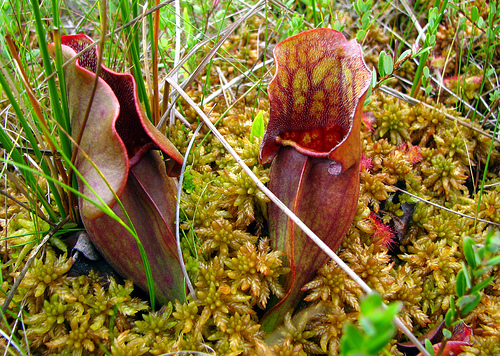
The acidic conditions caused by fallen conifer needles and poor nutrition on the forest floor spikes the competition in plants. In order to combat the small number of resources, some plants evolved to be carnivorous, use parasitism, and use mycorrhizae. 

https://blogger.googleusercontent.com/img/proxy/AVvXsEhe2D9scsLTup-RH6ou4Bc8G0ERSOLfs8MX_Cvx4vhqnEEiyIZCk4lZrkUyCC36lJULkvuaXRXnV5mwadvnYoV2eotpe4v8BBzddx3lBkktnXU9064_dj-1fQN35tIJOR-KIYevONMuWc8OdSdRQ27c7tnj2eqfelfe_OvRV9NoQohbTiEU6VVAnz-_HM7ZzEzqSZKBOAso=

Thank You! 

SOURCES

Scientific American

Bright Hub

Marietta Education

Wikipedia