Monday, January 27, 2014

Ted Talk: Anthony Ayala


Ted Talk: Anthony Ayala


  • 1950s - 1st ever organ transplant (kidney)
  • number of people needing transplants doubled as time progressed but number of organs available remained the same. This is due to longer human lifespan. 
  • Every 30 secs, a patient dies from diseases that could be treated with tissue transplant. 
  • Bone regenerates every 10 years. Skin regenerates every 2 weeks.
  • Body's first reaction to injury is to seal away injury (organs, skin, etc). Scar tissue.
  • Materials can be used as bridge to regenerate tissue. 
  • Max amount body can regenerate is 1cm.
  • Injured patient -> take small part of tissue -> tease tissue and cells out (separating) -> grow in large quantity. Use scaffold to bring cells into body to regenerate new tissue. Once tissue regenerates, scaffold disintegrates. 
  • Engineered organs (muscle, blood vessel) using scaffold must be exercised for use in human body. 
  • Can use printer to print organs. Cells instead of ink.
  • Can use decellularized organ. Take donated organ, strip the cells, take cells and put it on the "skeleton" of cell. Use to create functional organ.
  • 90% people waiting for organs are waiting for kidneys.
  • Your own cells will not be rejected from the body. 
  • Stem cells


Tuesday, January 21, 2014

Your Inner Healers Article


iPSC (induced pluripotency stem cells) - stem cells produced from regular cells of an organism

  • Shinya Yamanaka of University of Kyoto (2006) revealed their formula for creating the iPSC. 
  • Scientists are working to develop this in order to gain more understanding on diseases that have evaded cures (diabetes 1, alzheimer's, parkinson's). 
  • The ability of being able to change a cell's identity is revolutionizing the way scientists look at human development. 
  • Although sophistication of technology has not yet reached the ability for humans to theoretically become immortal, it is a possibility that may ignite more ethical issues that embryonic stem cells.
Primordial Power
  • differentiation: when cells become less versatile and more specialized as time goes on. (mammal)
  • embryonic stem cells have the ability to become 220 different cell types. 
  • multipotent: cells which can only develop into specific families of cells types (muscle/bone)
  • adult "stem cells" just replace mature cells within a tissue. 
  • cells do not revert back to more primitive cell (in mammals) with the exception of cancer. 
  • cellular reprogramming: tricks mature cell to act as an embryonic cell. (cell nuclear transfer "cloning")
  • cloning: injecting adult cell into egg cell who's genetic material has been removed. 
  • attempts to create embryonic cells from human clone cells have failed. 
  • nuclear transfer looked into as possible way for replacing damaged cells/tissue. 
  • Yamanaka introduced genes normally active only in embryos into adult cells. 
  • introduced gene with retroviruses -> cell reprogrammed into pluripotent cell 
  • can avoid ethical and legal contraints
Identity Crisis

  • iPSC may look like embryonic stem cells and display molecular markers associated with pluripotent cells. 
  • pluripotency of a cell: ability of stem cells to produce a wide variety of body cell types in a petri dish, ability to produce teratoma (tumor containing cells from embryonic tissue lineages) when injected under skin of mouse, and capacity (when injected in mouse embryo) to contribute to development of tissue lineages. embryonic stem cells usually pass test, iPSC do not. 
  • viruses developing programming genes usually are not properly shut off. Important genes are not properly turned on. 


Sunday, December 15, 2013

Mitosis & Meiosis

Meiosis is the process of cellular division necessary for sexual reproduction in eukaryotes. The number of sets of chromosomes in the cell undergoing meiosis is reduced to half the original number. The cells produced by meiosis are either gametes (the usual case in animals) or otherwise usually spores from which gametes are ultimately produced (the case in land plants).


Mitosis is the process of cellular division. The cycle starts when a cell has previously replicated each of its chromosomes, separates the chromosomes in its cell nucleus, into two identical sets of chromosomes, each set with its own nucleus. It is followed immediately by cytokinesis. 


Plant & Animal Cells

In class, we observed dog fleas and plant cells with a microscope. We also created our own slides and observed cheek cell samples taken from our fellow students.

Plant cells viewed from the perspective of a microscope
Cluster of cheek cells observed from perspective of microscope
flee observed from perspective of microscope

Thursday, November 21, 2013

DiHybrid Cross


A dihybrid cross is a cross between two parents that breed true for different versions of two traits.

The Punnett Square allows you to be able to look at all the possibilities of traits in the offspring.


Wednesday, November 6, 2013

Compelling Escherichia Coli Bacteria to Glow (For Halloween)


(Sorry for the awkward spacing of the pictures Mr. Quick. I'm not really technologically competent/still cannot figure out how to use google docs)


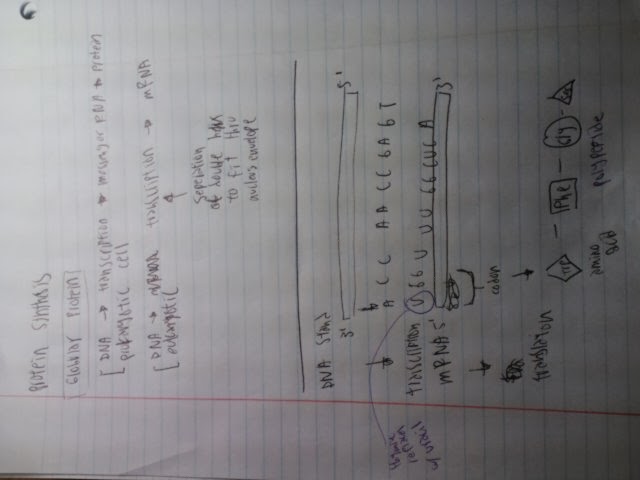
Protein Synthesis


Holy Cow
We learned wayyyyy too much about protein synthesis Mr. Quick. My head's gonna explode.

DNA -> RNA = transcription

RNA -> PROTEIN = translation


RNA

  • mRNA
    • made from one strand of DNA in nucleus - > leaves through a pore to find RIBOSOME in cytoplasm
  • rRNA
    • part of ribosome
  • tRNA
    • attached to amino acid
    • pairs with 3 letter codons on mRNA strand 
    • code for an amino acid

PROTEIN

  • made up of repeats of molecule called amino acid